
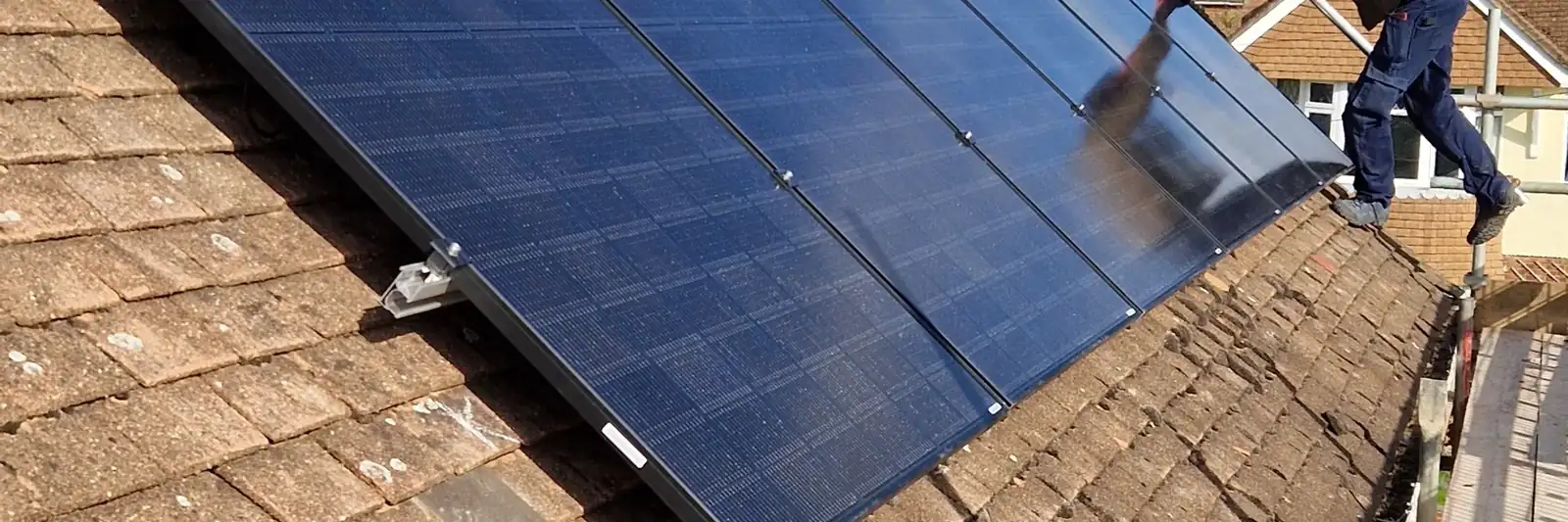
Solar Panel & Renewable Energy Installation in March
March is a Fenland market town with a strong food processing and logistics sector. The flat terrain and large agricultural buildings across the surrounding Fens make this area particularly well-suited to residential and commercial solar.
Renewable Energy in March, Cambridgeshire
March serves as the commercial hub for the northern Fenland area. Hostmoor Avenue Industrial Estate and March Trading Estate host food processing plants and distribution companies with large energy demands. The town is surrounded by prime Grade 1 Fenland farmland growing sugar beet, potatoes, cereals, and vegetables. Large packhouses and cold storage facilities require significant energy, making them ideal candidates for commercial solar with rapid payback periods. St Wendreda's Church, with its famous angel roof, is one of the town's historic landmarks.
Planning panels here? Our page on solar panel installation in March sets out system sizes, 2026 prices, the panels and inverters we fit and how an installation runs.
Why March Is Ideal for Solar
The flat Fenland landscape around March provides unobstructed solar exposure with virtually no shading issues. Solar irradiance averages 1,020 kWh/m² annually. Agricultural buildings and food processing factories offer large roof areas for commercial arrays.
Solar Panel Costs in March
Typical residential solar panel system prices in March. All prices include 0% VAT until March 2027.
| System Size | Cost (0% VAT) | Annual Savings | Payback |
|---|---|---|---|
| 3 kW | £4,000 - £6,000 | £450 - £625 | 7-10 years |
| 4 kW | £5,500 - £8,000 | £650 - £1,200 | 6-10 years |
| 5 kW | £6,500 - £9,000 | £775 - £1,325 | 6-9 years |
| 6 kW | £8,500 - £12,000 | £950 - £1,500 | 6-8 years |
Indicative prices for East Anglia. Exact pricing is confirmed during your free survey.
See our full solar panel cost guide for a complete breakdown.
Services Available in March
Government Grants for March Residents
Local Energy Facts for March
Environmental Impact in March
A typical March household switching to solar panels and a heat pump can achieve significant carbon reductions.
Equivalent to planting 220 trees or driving 12,000 fewer miles per year.
Planning in March
Fenland District Council generally supports renewable energy installations. Most residential and commercial properties have straightforward permitted development. Agricultural solar on farm buildings is typically well-supported.
About March
March grew on a fen 'island' amid drained peatland, and much of the surrounding farmland sits at or below sea level behind pumped drainage — ground-mounted arrays and heat-pump groundworks here need fen-aware foundations. The historic town centre is a conservation area designated in 1972, and the Grade I listed St Wendreda's Church with its famous 120-angel double hammerbeam roof means street-visible installs warrant a planning check. Housing spans railway-era Victorian terraces — Whitemoor was Britain's largest marshalling yard in the 1930s — and major new estates: 1,200 homes approved west of The Avenue in 2024, part of March's 2,746-home target by 2040. Fenland councillors refused a 49.8MW solar farm at West Fen Farm in January 2026 over farmland loss, and low-income households can access retrofit funding through the Warm Homes: Local Grant via Action on Energy Cambridgeshire.
Why Install Renewables in March?
- Lower-income households around March can get funded insulation and low-carbon heating through the Warm Homes: Local Grant — the successor to HUG2 — delivered locally by Action on Energy Cambridgeshire, where demand is high enough that a waiting list is running.
- With 1,200 homes approved west of The Avenue in 2024 and a 2,746-home target for March by 2040, retrofit solar lets owners of the town's older railway-era terraces match new-build energy standards.
- Fenland councillors unanimously refused a 49.8MW solar farm with battery storage at West Fen Farm near March in January 2026 over the loss of farmland — rooftop panels and home batteries face no such planning battle and let March householders capture that fen sunshine directly.
- Homes inside the 1972 town-centre conservation area or near Grade I St Wendreda's may need planning advice for street-visible panels, so an installer who designs rear-slope or in-roof arrays matters here.
Why Choose Green Hat in March?
March and the Fenland area have few dedicated local renewable energy providers. Most competitors are based in Cambridge or Peterborough. Green Hat offers direct Fenland access from our Isleham base and specialises in agricultural solar — critical for the food processing and farming economy around March.
- Agricultural solar expertise for packhouses, cold stores, and grain drying facilities
- Direct Fenland access: 22 miles from our base, often faster than Cambridge-based competitors
- Commercial solar experience for food processing factories on Hostmoor Avenue
- Full service: solar, battery storage, heat pumps, EV chargers under one roof
- Covering all PE15 postcodes and surrounding Fenland villages
Installation Timeline in March
March surveys booked within 7 days. Residential installations 3-5 weeks. Commercial food processing projects 6-10 weeks depending on scale and operational scheduling.
Also Serving Near March
What March Customers Say
"Had 80kW of solar installed across two barn roofs on our Fenland farm. The panels are generating huge amounts of electricity — the flat terrain and open skies here are perfect. Green Hat understood farming schedules and worked around our operations."
"Green Hat fitted a large ground-mounted system in our paddock. The planning application was handled by their team and approved without issue. The system generates more than our entire farm energy usage — we now have a net export income as well as zero electricity bills."
Guides & Articles for March
Frequently Asked Questions — March
Do you install solar panels in March?
Yes. March is within our core service area, just 22 miles from our base in Isleham. We provide the full range of renewable energy services including solar panels, battery storage, heat pumps, EV chargers, underfloor heating, insulation, and MVHR.
How much do solar panels cost in March?
Solar panel costs in March are consistent with the wider East Anglia region. A typical 4kW residential system costs £4,700–£6,700, while a larger 6kW+ system costs £6,700–£9,200. All prices include 0% VAT. We provide exact pricing during your free survey. We cover all PE15 postcodes.
Is March good for solar panels?
The flat Fenland landscape around March provides unobstructed solar exposure with virtually no shading issues. Solar irradiance averages 1,020 kWh/m² annually. Agricultural buildings and food processing factories offer large roof areas for commercial arrays. March sits in the heart of the Cambridgeshire Fens — one of the driest and flattest regions in England. The unobstructed horizon in all directions maximises solar exposure throughout the day.
Do I need planning permission for solar panels in March?
Fenland District Council generally supports renewable energy installations. Most residential and commercial properties have straightforward permitted development. Agricultural solar on farm buildings is typically well-supported.
What areas around March do you cover?
In addition to March itself, we serve Chatteris, Doddington, Manea, Wimblington, Whittlesey, Benwick, and all surrounding villages and hamlets. We cover all PE15 postcodes. Our team knows the local area and can reach most properties within 30 minutes.
Can I get a heat pump grant in March?
Yes. The Boiler Upgrade Scheme provides £7,500 towards air source heat pump installation for March homeowners. The MCS-certified heat pump installer applies for the grant on your behalf. Additionally: Cambridgeshire HUG2 scheme (Fenland District Council). PE15 eligible. Combined with 0% VAT, a heat pump can cost as little as £500–£2,500 for eligible households.
Is March suitable for a heat pump?
March town has mains gas. Surrounding Fenland villages (Manea, Benwick, Doddington) have mixed gas availability. Food processing factories and cold storage facilities on Hostmoor Avenue have massive energy demands ideal for commercial solar. We provide free home suitability assessments with every survey.
What solar battery storage options are available in March?
We install GivEnergy, Tesla Powerwall, and SolarEdge battery systems in March. A 9.5kWh GivEnergy battery typically costs £2,500–£3,500 installed and is eligible for 0% VAT. With smart tariffs like Octopus Flux, a battery in March can save an additional £500–£900/year on top of solar savings. We have a dedicated March battery storage page with local pricing and FAQ.
Renewables across Cambridgeshire — not just March
Everything we fit in March is fitted by our own engineers, not subcontracted to a national panel. March is 22 miles from the workshop. We install our East Anglia solar panel service and our East Anglia heat pump service, and both pages set out exactly where our coverage stops.
Both regional pages list what we install, what it costs and where we will and will not travel. If March is not listed on them, it is still inside the radius — ask us about March and we will tell you straight whether the job is one we should be quoting.
Ready for Renewable Energy in March?
Get your free, no-obligation survey and personalised quote. Our MCS-certified team is ready to help you save money and reduce your carbon footprint.
Request a callback
Name and number is enough — we call within 24 hours.