
Ground Source vs Air Source Heat Pump: Which Is Best?
Both types qualify for the £7,500 BUS grant and provide carbon-free heating. But they differ significantly in cost, efficiency, land requirements, and which property types they suit. Here is an honest comparison for East Anglia homeowners.
Head-to-Head Comparison
| Attribute | Air Source (ASHP) | Ground Source (GSHP) |
|---|---|---|
| Typical installed cost | ★ £8,000–£13,000 | £20,000–£45,000 |
| BUS grant | £7,500 | £7,500 |
| Net cost after grant | ★ £500–£5,500 | £12,500–£37,500 |
| Typical SCOP efficiency | 3.2–4.5 | ★ 4.0–5.0 |
| Winter efficiency dip | Yes (air gets cold) | ★ Minimal (ground stays warm) |
| Outdoor noise | 40–52 dB(A) outdoor unit | ★ None outdoors |
| Land required | ★ Minimal (unit on wall/ground) | 200–600m² (horizontal) or boreholes |
| Installation disruption | ★ Moderate (2–4 days) | Significant (ground works + 2–4 days) |
| Payback period | ★ 8–12 years | 12–20 years |
| Lifespan | 15–20 years | ★ 20–25 years (loop: 50+ years) |
| Running costs vs gas boiler | 20–40% lower | ★ 30–50% lower |
| Best property type | Terraces, semis, modern homes | Rural properties with land |
How Each System Works
Air Source Heat Pump
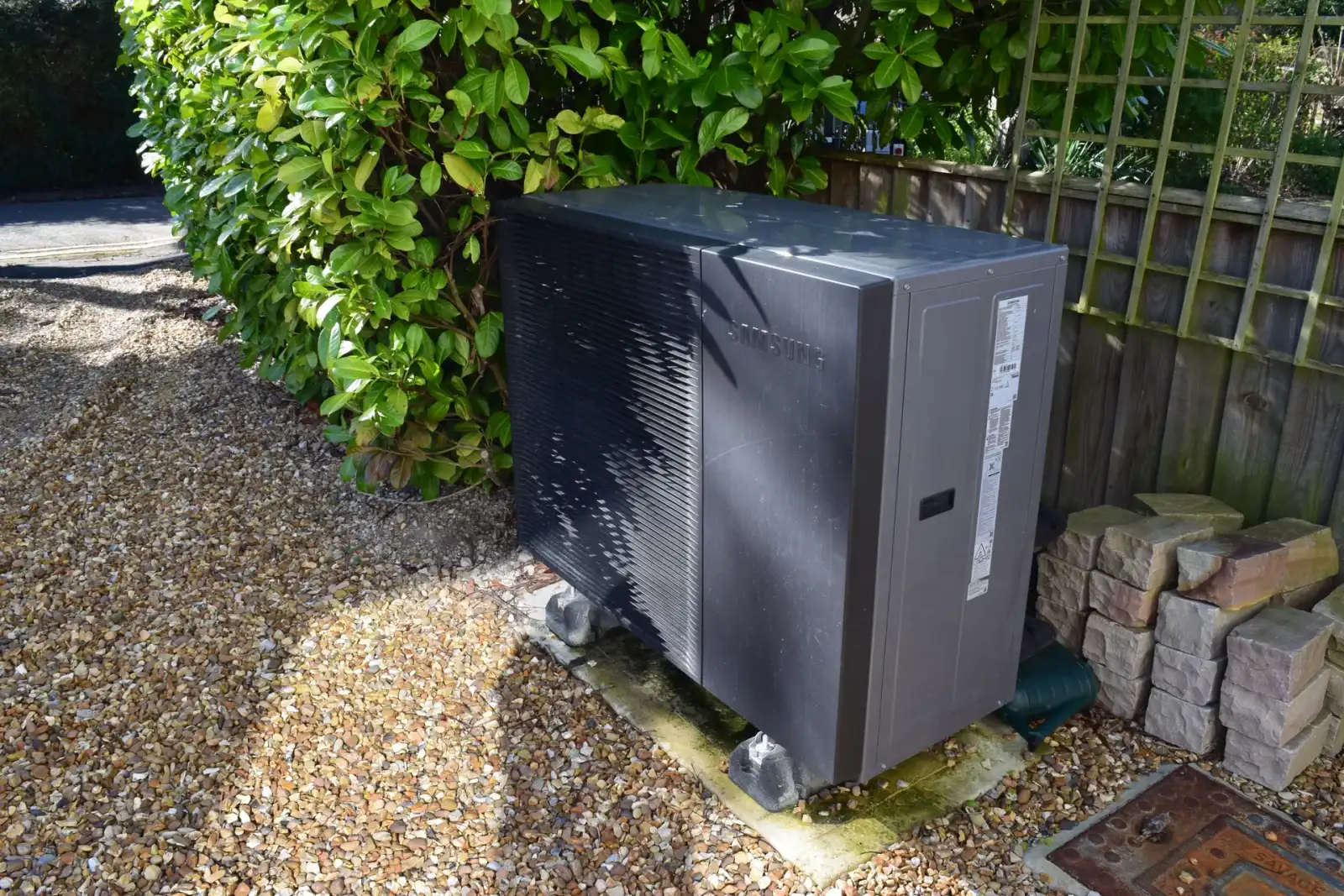
Extracts heat from outdoor air using refrigerant and a compressor. The outdoor unit (similar in size to an air conditioning unit) draws in air over a heat exchanger. Effective down to -20°C, though efficiency reduces as outdoor temperature drops. No ground works required — the unit mounts on a wall or sits on a base pad.
Ground Source Heat Pump
Extracts heat from the ground using buried pipes (a ground loop or boreholes) filled with a water/antifreeze mixture. The ground maintains 8–12°C year-round. Higher efficiency than ASHP due to stable ground temperature, but requires significant ground works — either extensive horizontal trenching or vertical boreholes.
Which Is Right for Your East Anglia Home?
Cambridge terrace or semi-detached
Air source heat pumpLimited garden space rules out horizontal ground loops. Vertical boreholes in urban settings are expensive and logistically complex. A modern ASHP (Daikin Altherma, Vaillant arotherm+) fits on the rear wall with minimal disruption and qualifies for the full £7,500 BUS grant.
Norfolk or Suffolk rural farmhouse (0.5+ acres)
Consider ground sourceLarge gardens or farmland make horizontal ground loops practical and cost-effective. East Anglia's flat topography is ideal for ground works. The higher efficiency offsets the higher upfront cost over the heat pump's 20–25 year lifespan, especially for properties with high heating demand.
Converted barn or agricultural building
Either — survey requiredDepends on the available land, garden layout, and planning constraints. Former agricultural land adjacent to a converted barn may be ideal for ground loops. We assess both options during the survey and recommend the most cost-effective choice for your specific site.
Peterborough or Norwich suburban house
Air source heat pumpStandard suburban garden sizes (50–150m²) are generally insufficient for horizontal ground loops. Air source is the practical and cost-effective choice. The grant savings and lower upfront cost typically outweigh the small efficiency advantage of GSHP for most suburban properties.
Frequently Asked Questions
Which is cheaper to install — air source or ground source?
Air source heat pumps are significantly cheaper to install. A typical 8–12kW ASHP installed costs £8,000–£13,000 before the £7,500 BUS grant (net cost £500–£5,500). A ground source heat pump including boreholes or ground loops costs £20,000–£45,000 depending on ground conditions and loop type — substantially more even after the £7,500 BUS grant.
Which is more efficient — air source or ground source?
Ground source heat pumps are typically more efficient than air source, because the ground maintains a stable temperature of 8–12°C year-round, whereas air temperature drops in winter when heating demand is highest. A GSHP achieves SCOP 4.0–5.0 (400–500% efficiency). A modern ASHP achieves SCOP 3.2–4.5 — still far more efficient than a gas boiler (80–90%) but lower than GSHP at peak demand.
Can I get the £7,500 BUS grant for a ground source heat pump?
Yes. The Boiler Upgrade Scheme grant of £7,500 applies to both air source and ground source heat pumps. Ground source heat pumps were previously eligible for £6,000, but the grant was equalised to £7,500 in 2023. To claim the grant, the installation must be carried out by an MCS-certified installer and the property must have an EPC rating of D or above (E–G ratings may require efficiency improvements first).
How much land do you need for a ground source heat pump?
For a horizontal ground loop system, you need a garden area approximately 2–3 times the floor area of your home. A 3-bed house needing a 6kW system typically requires 200–600m² of suitable ground — approximately 0.06 acres. For properties with smaller gardens, vertical boreholes are an alternative: typically 2–4 boreholes of 100m depth, each requiring a drilling pad of approximately 5m². Boreholes cost more but require less land area.
Is ground source heat pump better for rural East Anglia properties?
Ground source is particularly well-suited to rural East Anglia properties with large gardens or farmland. Norfolk and Suffolk have extensive agricultural land, flat topography (easier drilling), and many larger period properties that benefit from the higher efficiency of GSHP. For a Suffolk farmhouse or converted barn with half an acre or more, a GSHP with horizontal ground loops is a very viable option.
How noisy is a ground source heat pump compared to air source?
Ground source heat pumps are significantly quieter than air source, because there is no outdoor fan unit — the heat extraction from the ground loop is silent. The only noise comes from the compressor unit inside the property, typically in a plant room or utility room, producing 40–45 dB(A). There are no planning or permitted development noise constraints for GSHP equivalent to the 37 dB(A) outdoor rule for ASHP.
Which heat pump type is right for a Cambridge terrace?
For a Cambridge terrace with a small rear garden, air source is the practical choice. Terraced houses typically lack the garden area for a horizontal ground loop, and drilling vertical boreholes in an urban terrace setting is expensive and logistically complex. A modern air source heat pump (Daikin Altherma, Vaillant arotherm+) can be mounted on the rear wall, subject to the 37 dB(A) permitted development limit.
Can a ground source heat pump use my existing radiators?
The same considerations apply as for air source — the heat pump's flow temperature (35–55°C) determines whether existing radiators are adequately sized. Ground source heat pumps can typically achieve slightly lower flow temperatures due to higher ground temperatures, but may still require some radiator upgrades. The best option for both GSHP and ASHP is underfloor heating at 35°C, which matches the optimal flow temperature exactly.
Not Sure Which Is Right for Your Property?
Our free heat pump survey assesses your property for both air source and ground source options. We provide a clear recommendation and a quote for both where applicable, so you can make an informed decision.
Ready to Switch to Clean Energy?
Get your free, no-obligation survey and personalised quote. Our MCS-certified team is ready to help you save money and reduce your carbon footprint.
Request a callback
Name and number is enough — we call within 24 hours.