

External Wall Insulation
Wrap your home in warmth and slash energy bills
External wall insulation typically costs £8,000–£15,000 for a semi-detached home, cuts wall heat loss by up to 70%, and can lift an EPC by two or more bands. ECO4 funding covers some or all of the cost for qualifying East Anglia households — we check eligibility at the free survey.
About External Wall Insulation
External wall insulation (EWI) is one of the most effective ways to reduce heat loss from solid-walled properties common across East Anglia. Many Victorian and Edwardian homes in Cambridge, Bury St Edmunds, and Norwich have solid brick walls with no cavity, losing up to 35% of heat through their walls. By wrapping your home in insulation and protective render, we can cut that heat loss by up to 70% and improve your EPC rating by two or more bands.
Key Benefits
Heat Pump Costs (After BUS Grant)
Insulation is the essential first step before installing a heat pump. These heat pump costs show the savings you unlock once your walls are insulated.
| Property | Heat Pump Size | HP Net Cost | Annual Running |
|---|---|---|---|
| 1-2 bed | 5-6 kW | £0 - £2,500 | £610 - £720 |
| 3-bed semi | 8-10 kW | £500 - £5,500 | £610 - £720 |
| 4-bed detached | 10-12 kW | £3,500 - £10,500 | £610 - £720 |
Helpful Guides
Our Installation Process
Property Assessment
We survey your property, assess wall construction, check for damp issues, and measure all elevations for accurate quoting.
System Selection
We recommend the optimal insulation thickness and render finish based on your wall type, budget, and aesthetic preferences.
Installation
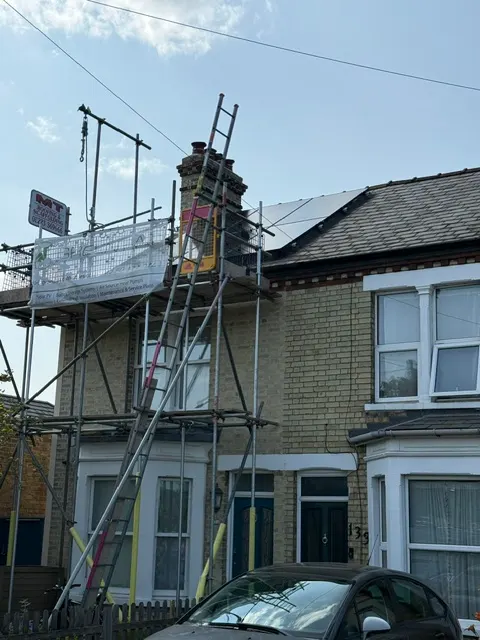
Scaffolding is erected and insulation boards are mechanically fixed and adhesive-bonded to external walls, followed by mesh reinforcement and render application.
Finishing
Final render coat is applied in your chosen colour and texture. We remove scaffolding, clean up, and update your EPC certificate.
Typical Timeline
Works Well With
Insulate first, then install a smaller, cheaper heat pump. The correct order saves thousands.
Airtight insulated homes need mechanical ventilation to maintain fresh air quality.
Insulation reduces total energy demand, meaning solar can cover a larger share of your bills.
Financing
EWI costs £90-£150/m². Mid-terrace £6,000-£10,000; semi £8,000-£15,000; detached £18,000-£30,000. ECO4 may cover full cost (ending 31 Dec 2026). Warm Homes Local Grant (up to £15,000) from 2027. U-value improves from 2.1 to 0.29 W/m²K (86% improvement).
Warranty
- 25-year system warranty
- 10-year workmanship guarantee
- BBA certified EPS, mineral wool, or phenolic systems
- Range of render finishes available
Popular Combinations
Combine services for greater savings. All figures based on typical East Anglia households.
Insulation + Heat Pump
Insulate first, then a smaller heat pump works harder for less. The correct upgrade order.
Insulation + Heat Pump + MVHR
The complete fabric-first retrofit. Airtight, insulated, ventilated, and efficiently heated.
Related Articles
External wall insulation: what the 0% VAT covers, and who is allowed to fit it under ECO4
Insulation is one of the materials HMRC actually zero-rates. VAT Notice 708/6 defines energy-saving materials to include insulation for walls, floors, ceilings, roofs, lofts, pipes and tanks, which covers both external and internal wall insulation on an existing home. The zero rate runs to 31 March 2027 and then reverts to the reduced rate of 5%. That is a real saving on a job of this size, and it is one of the few reliefs in this sector that does not depend on your income, your EPC band or an application form.
It is worth being precise about what the relief attaches to, because the confusion costs people money. The zero rate is for the installation of the qualifying material in residential accommodation. It does not extend to unrelated building work carried out at the same time, and it does not turn a general refurbishment into a zero-rated job because insulation forms part of it. If you are having render, windows and insulation done together, expect the invoice to be split, and expect a competent contractor to show you the split rather than quoting one blended number.
The second question people ask is who is allowed to do the work when it is funded rather than paid for. Under ECO4, Ofgem requires that all installers must be a TrustMark registered business, and ECO4 projects involving measures covered by PAS 2035 must follow the domestic retrofit process that standard sets out — assessment, a retrofit coordinator, a designed package rather than a single measure bolted on. That is why a funded external wall insulation job takes longer to start than a private one: the coordination is part of the standard, not padding.
We are straight about our own position in that chain. Green Hat is MCS certified and a RECC member, and where a household qualifies for ECO4 we assess eligibility and manage the application, delivering the measures with TrustMark-registered ECO4 installers rather than claiming a registration we do not hold. If a company tells you it is an ECO4 approved installer, ask which TrustMark number that sits under — it is a public register and the answer takes a minute to check.
- External and internal wall insulation are zero-rated for VAT until 31 March 2027, then 5% (VAT Notice 708/6, section 2.10)
- The relief attaches to the qualifying material only — expect a split invoice where other work runs alongside
- ECO4 requires a TrustMark registered installer (Ofgem), and PAS 2035 measures follow the full retrofit process
- Ask any 'ECO4 approved installer' for the TrustMark number — the register is public
Frequently Asked Questions
What is external wall insulation?
EWI involves fixing insulation boards (typically 90-150mm thick) to the outside of your walls, then covering with a protective render finish. It is particularly effective for solid-walled properties that cannot have cavity wall insulation.
How much can I save with external wall insulation?
Depending on your property size and current insulation levels, EWI can save £200-£500 per year on heating bills. Combined with a heat pump, the savings compound significantly. Many properties also improve by 2+ EPC bands.
Does EWI require planning permission?
Most EWI installations are covered under permitted development. However, listed buildings, conservation areas, and significant changes to appearance may require permission. We check planning requirements during our initial assessment.
What is the ECO4 scheme and do I qualify?
ECO4 (Energy Company Obligation) provides free or heavily subsidised insulation for eligible households. You may qualify if you receive certain benefits (Universal Credit, Pension Credit, Child Tax Credits) or live in a low-EPC-rated property (D, E, F, or G). We can check your eligibility and handle the application process, delivering the measures with TrustMark-registered ECO4 installers.
Ready to Switch to Clean Energy?
Get your free, no-obligation survey and personalised quote. Our MCS-certified team is ready to help you save money and reduce your carbon footprint.
Request a callback
Name and number is enough — we call within 24 hours.