
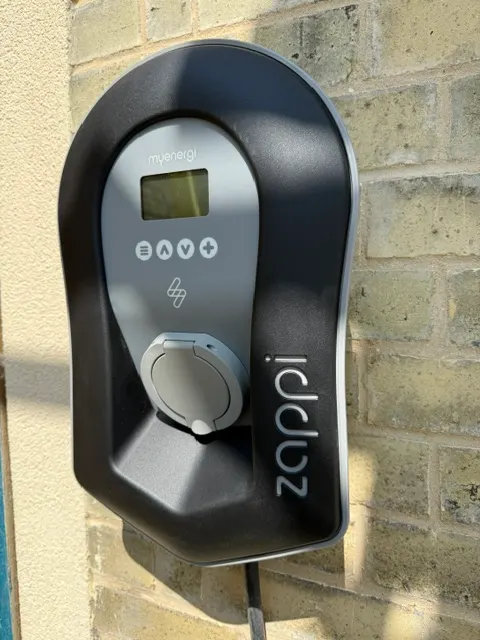
Installing a home EV charger is one of the best investments for electric vehicle owners. Compared to public charging at 40-80p/kWh, home charging costs just 7-24p/kWh depending on your tariff. Combined with solar panels, you can charge your car for free using surplus energy from your roof. See our solar panel costs guide for current system pricing. This guide covers 2026 EV charger costs, brand comparisons, and how to maximise savings with solar and smart tariffs across Cambridgeshire, Norfolk, and Suffolk.
EV Charging at a Glance
EV Charger Costs by Brand
| Charger | Power | Price Installed | Solar Compatible | Features |
|---|---|---|---|---|
| Ohme Home Pro | 7.4 kW | £850 - £1,300 | Good | Smart tariff integration (Intelligent Octopus) |
| myenergi Zappi | 7.4 kW | £1,000 - £1,400 | Excellent | Solar divert ECO/ECO+ modes, UK-made |
| Easee One | 7.4 kW | £900 - £1,200 | Good | Design-led, dual-EV load balancing |
| Hypervolt Home 3 Pro | 7.4 kW | ~£1,300 | Good | Longest warranty, British-made |
| Pod Point Solo 3S | 7.4 kW | £800 - £1,100 | Basic | Simple setup, app control |
| Tesla Wall Connector | 7.4 - 22 kW | £750 - £1,000 | Good | Tesla app integration |
Prices include standard installation (up to 10m cable run from consumer unit). More complex installations may cost £100-£300 extra.
Our Recommended Chargers
Zappi v2 - Best for Solar Owners
The Zappi is the gold standard for solar integration. Its built-in CT clamp and solar divert mode automatically use surplus solar energy to charge your EV before exporting to the grid. Three modes: Fast (full power), Eco (solar only), and Eco+ (solar with grid top-up). Also integrates with smart tariffs for overnight charging. £850-£1,100 installed.
Ohme Home Pro - Best for Smart Tariffs
The Ohme excels at smart tariff integration, particularly with Octopus Energy. It automatically schedules charging during the cheapest periods based on your tariff and departure time. The app shows real-time costs and scheduling. Good solar integration via API. £750-£950 installed.
Easee One - Best Design
The Easee is the sleekest and smallest charger on the market, ideal if aesthetics matter. Full smart functionality with app control and scheduling. Good for homes without solar where simplicity and design are priorities. £700-£900 installed.
Smart Tariff Savings
Smart EV tariffs like Octopus Intelligent Go offer 7-12p/kWh overnight rates vs 24-28p/kWh standard rates. For a driver covering 10,000 miles/year, this saves £300-£400 annually compared to standard tariffs, and £1,500+ compared to petrol. The charger pays for itself within 2-3 years.
Solar + EV Charging
Combining solar panels with an EV charger is the ultimate setup for low-cost, zero-carbon driving. During summer months, a 4kW solar system typically generates 15-25kWh of surplus energy on sunny days, enough for 50-90 miles of free driving. Adding battery storage lets you store daytime surplus and charge overnight, maximising self-consumption further.
Typical Solar Charging Scenario
Running Cost Comparison
| Fuel Type | Cost per Mile | 10,000 Miles/Year | Annual Saving vs Petrol |
|---|---|---|---|
| Petrol (50mpg) | 15-18p | £1,500-£1,800 | - |
| Home Charging (Standard) | 6-8p | £600-£800 | £900-£1,000 |
| Home Charging (Smart Tariff) | 2-4p | £200-£400 | £1,300-£1,400 |
| Home Charging (Solar) | 0p | £0 (free) | £1,500-£1,800 |
| Public Charging | 12-24p | £1,200-£2,400 | £0-£600 |
Installation Process
Key Benefits
Frequently Asked Questions
How long does it take to charge an electric car at home?
With a 7.4kW home charger, most EVs charge from 20% to 80% in 4-6 hours. A typical overnight charge (11pm-7am) provides 50-55 kWh, enough for 180-220 miles of range. Smaller batteries like the MG4 (51kWh) charge faster than larger ones like the BMW iX (105kWh).
Can I charge my EV from solar panels?
Yes. Smart chargers like the Zappi can divert surplus solar energy to your EV automatically. On a sunny summer day, a 4kW solar system can provide 15-25 kWh of free charging, enough for 50-90 miles. Combining solar, battery storage, and smart EV charging maximises self-consumption and minimises grid costs.
What is the difference between 7kW and 22kW chargers?
A 7.4kW charger uses a standard single-phase electricity supply (what most UK homes have) and charges at 25-30 miles of range per hour. A 22kW charger requires a three-phase supply (usually only available in commercial properties or some new builds) and charges 3x faster. For most homes, 7.4kW is ideal and sufficient.
Do I need a dedicated circuit for an EV charger?
Yes. EV chargers must be installed on a dedicated circuit from your consumer unit for safety. This is a building regulations requirement. Our installation includes all necessary electrical work, circuit protection, and connection to your existing supply.
How much does it cost to run an EV charger?
Charging at home costs around 7-24p per kWh depending on your tariff. At the average rate of 24.5p/kWh, charging a typical 60kWh EV from empty costs about £14.70 for 200+ miles of range. Smart tariffs like Octopus Go offer 7-12p/kWh overnight, reducing costs to £4-7 per full charge.
Will my home electrics cope with an EV charger?
Most homes with a modern consumer unit and 60-100A main fuse can accommodate a 7.4kW charger. Our surveyor will check your supply capacity and consumer unit before installation. If upgrades are needed (e.g., main fuse upgrade), we will advise on costs and arrange this as part of the installation.