
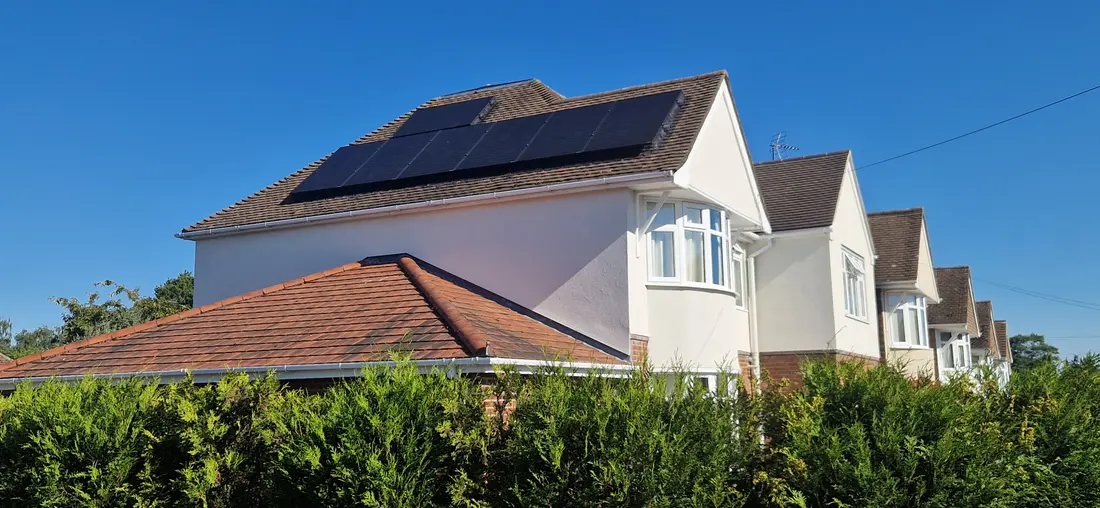
What Solar Panels Cost in Suffolk
National cost guides give you a range; this page gives you the Suffolk numbers behind it. We take the European Commission's PVGIS yield for three Suffolk towns, the electricity rate in force this quarter and the VAT window, and work one typical system through to payback. The full UK comparison tables are on our solar panel costs guide; this page is the county example that plugs into them.
1,042
kWh per kWp a year, Bury St Edmunds (PVGIS)
26.32p
per kWh, Ofgem price cap Oct–Dec 2026
0% VAT
on domestic solar to 31 March 2027
How much sun a Suffolk roof actually gets
PVGIS, the European Commission's solar database, models an optimally tilted, south-facing array at 35 degrees. For one kilowatt of panels it gives 1,042 kWh a year in Bury St Edmunds, 1,056 in Lowestoft and 1,079 in Ipswich — against 1,029 for Cambridge and Ely. The east coast is the sunniest part of the county, and all of Suffolk is a little ahead of inland Cambridgeshire. Real roofs are rarely a perfect 35-degree south pitch, which is why the conservative generation figures in our cost guide work out at roughly 850–900 kWh per kilowatt rather than the PVGIS ideal; the table below uses those conservative figures.
| Location | kWh per kWp per year |
|---|---|
| Ipswich | 1,079 |
| Lowestoft | 1,056 |
| Bury St Edmunds | 1,042 |
| Cambridge / Ely (for comparison) | 1,029 |
PVGIS annual yield, 1 kWp, 35° tilt, south-facing, 14% system loss
Installed prices by system size
These are the same figures our solar panel costs guide uses for East Anglia as a whole, quoted at the 0% VAT rate that applies to domestic installations in Great Britain until 31 March 2027. Suffolk does not carry a premium: the variables that move a Suffolk quote are roof complexity (slate and pantile roofs in the older market towns), scaffolding access on terraced streets, and whether a battery is added at the same time.
| System | Panels | Installed cost | Annual generation | Payback |
|---|---|---|---|---|
| 3 kW | 8-10 panels | £4,000 - £6,000 | 2,550 - 2,850 kWh | 7-10 years |
| 4 kW | 10-14 panels | £5,500 - £8,000 | 3,400 - 3,600 kWh | 6-10 years |
| 5 kW | 12-16 panels | £6,500 - £9,000 | 4,250 - 4,500 kWh | 6-9 years |
| 6 kW | 16-20 panels | £8,500 - £12,000 | 5,100 - 5,700 kWh | 6-8 years |
Residential solar in Suffolk, supply and installation, 0% VAT to 31 March 2027
A worked example: 4 kW in Bury St Edmunds
Take the 4 kW system from the table — 10 to 14 panels, £5,500 to £8,000 installed, generating a conservative 3,400 to 3,600 kWh a year on a Bury St Edmunds roof. At the Ofgem price cap rate for October to December 2026 of 26.32p per kWh, 3,500 kWh is worth about £920 a year if every unit were used at home. Nobody uses every unit: a household out during the day without a battery typically uses a fraction of its own generation and exports the rest, so if you used half at home that is roughly £460 a year off the import bill, plus whatever your supplier pays under the Smart Export Guarantee for the other half. The supplier sets that export rate, so it is worth comparing before you sign up.
A battery changes the arithmetic by moving the exported half into the evening, which is why the battery storage in Suffolk page sits beside this one: the same 4 kW system with storage keeps most of its 3,500 kWh at the 26.32p import rate rather than the export rate. Our solar panel costs guide carries the full comparison by system size and panel brand; our 2026 price guide tracks what has changed in the market this year.
Switch Together Suffolk, planning and the deadline that matters
Suffolk County Council's group-buying scheme, Switch Together Suffolk (previously Solar Together Suffolk), closed its 2026 registration on 24 July 2026; the council reports 32,024 panels installed on 2,651 households through the scheme by September 2025. A scheme quote is a useful benchmark for a standard package. An independent quote is sized to your roof and your usage, and includes the survey, scaffolding and DNO registration as itemised lines so the two can be compared like for like.
Planning in Suffolk follows the national permitted development rules for roof-mounted panels, with the usual exceptions: listed buildings always need consent, and in town-centre conservation areas — Bury St Edmunds, Lavenham, Woodbridge, Southwold — panels visible from the road can need an application. The solar panel installation in Bury St Edmunds page covers the West Suffolk rules in detail; the Suffolk towns index links the rest.
The deadline is VAT. HMRC zero-rates the installation of solar panels in residential accommodation in Great Britain until 31 March 2027, after which the reduced 5% rate returns (VAT Notice 708/6). On the 4 kW example that is £275–£400 of difference between a system fitted in March 2027 and the same one fitted in April.
Solar panel installation by Suffolk town
Each town page covers roof types, the planning authority and local notes; the figures on this page apply across the county.
Solar panel costs in Suffolk: common questions
How much do solar panels cost in Suffolk?
The same as the rest of East Anglia: roughly £5,500–£8,000 installed for a 4 kW system (10–14 panels) and £6,500–£9,000 for 5 kW, at the 0% VAT rate that applies to domestic installations until 31 March 2027. What moves a Suffolk quote is the roof — slate or pantile, dormers, scaffolding access — not the county.
How much electricity will solar panels generate in Suffolk?
PVGIS puts an ideal south-facing roof at 1,042 kWh per installed kilowatt a year in Bury St Edmunds, 1,056 in Lowestoft and 1,079 in Ipswich. Real roofs generate less than the ideal, so we quote conservatively: around 3,400–3,600 kWh a year for a 4 kW system.
Is there a solar panel grant in Suffolk?
There is no county grant for solar panels. The support that exists is the 0% VAT rate on domestic solar and battery installations until 31 March 2027, the Smart Export Guarantee payments for exported electricity, and for qualifying low-income or off-gas households the national schemes covered on our grants pages. Switch Together Suffolk is a group-buying scheme, not a grant.
Do I need planning permission for solar panels in Suffolk?
Usually not — roof-mounted panels on an ordinary house are permitted development. Listed buildings always need consent, and in conservation areas such as Bury St Edmunds town centre or Lavenham, panels visible from the highway can need an application to the district council. We check the designation at survey.
What is the payback period for solar panels in Suffolk?
Our cost guide works to 6–10 years for a 4 kW system, depending on how much of the generation you use at home and the export rate your supplier pays. A battery shortens it by keeping more of the generation at the import price; a home that is empty all day without a battery sits at the longer end.
Sources (checked 29 October 2026)
- PVGIS v5.2 (PVGIS-SARAH2), European Commission JRC: 1 kWp, 14% system loss, 35° tilt, south-facing — Bury St Edmunds 1,042 kWh, Ipswich 1,079 kWh, Lowestoft 1,056 kWh, Cambridge/Ely 1,029 kWh per year
- Ofgem, energy price cap 1 October – 31 December 2026: GB-average Direct Debit electricity 26.32p/kWh
- Ofgem, Smart Export Guarantee: export rates are set by each licensed supplier
- HMRC VAT Notice 708/6: zero rate on energy-saving materials in residential accommodation, 1 May 2023 – 31 March 2027; 5% from 1 April 2027
- Suffolk County Council / Ipswich Borough Council: Switch Together Suffolk 2026 round (applications closed 24 July 2026); 32,024 panels on 2,651 households by September 2025
- Installed prices and generation: Green Hat Renewables cost schedule (src/data/costs.ts), the same figures as /guides/solar-panel-costs/
Want the Suffolk numbers for your own roof?
Get your free, no-obligation survey and personalised quote. Our MCS-certified team is ready to help you save money and reduce your carbon footprint.
Request a callback
Name and number is enough — we call within 24 hours.