
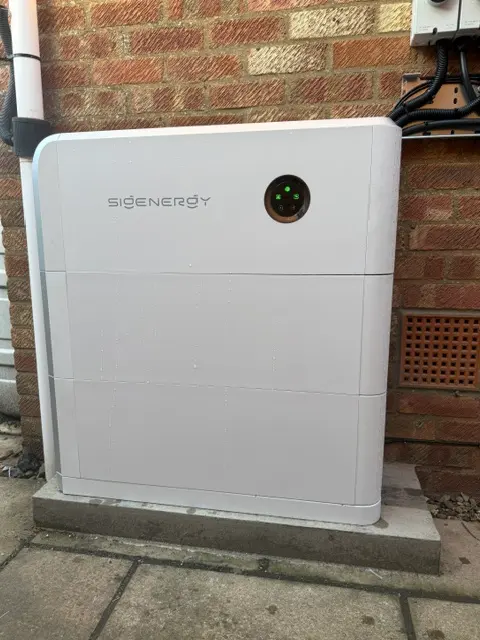
Battery Storage in Suffolk
Suffolk has more detached, owner-occupied homes than England as a whole and one of the highest shares of oil-heated households in the country, which is why a battery here is rarely just about solar: it is about buying electricity when it is cheap and keeping the house running when the overhead line goes down. This page covers the county-level questions — the grid connection, the VAT window, the council scheme — and links to the Suffolk town pages for what is local to each place.
1,042–1,079
kWh per kWp a year across Suffolk (PVGIS)
0% VAT
on home batteries to 31 March 2027
3.68 kW
G98 limit per phase before a G99 application
Why a battery earns more in Suffolk than the brochure suggests
Start with the roof. PVGIS, the European Commission's solar yield database, puts a south-facing array at 35 degrees in Bury St Edmunds at 1,042 kWh per installed kilowatt a year, Lowestoft at 1,056 and Ipswich at 1,079 — all above the 1,029 it gives Ely and Cambridge, because the coast is sunnier. Real roofs run lower than that ideal, but the ranking holds: a Suffolk roof generates a little more than a Cambridgeshire one, and a battery is what turns the afternoon surplus into evening use instead of a few pence of export.
Then the tariff. The Ofgem price cap for 1 October to 31 December 2026 sets a GB-average Direct Debit electricity unit rate of 26.32p per kWh with a 54.83p daily standing charge, and the Smart Export Guarantee lets each licensed supplier set its own export rate as long as it is above zero. The gap between what you pay and what you are paid for the same kilowatt-hour is the battery's whole business case, and it is at its widest on the time-of-use tariffs that charge the battery overnight at a few pence and discharge it through the evening peak.
Finally the house. In the 2021 Census, 35.2% of Suffolk households lived in a detached house or bungalow against 22.9% across England, 65.4% owned their home, and 13.2% heated with oil alone (England: 3.2%), rising to 30.3% in Mid Suffolk. Detached, owner-occupied, off-gas homes have the space for a battery, no landlord to ask, and the strongest reason to pair one with a heat pump running on cheap-rate electricity.
Grid connection in Suffolk: UK Power Networks, G98 and G99
Suffolk's electricity network is operated by UK Power Networks under its Eastern Power Networks licence (the Energy Networks Association lists Eastern England, distributor ID 10, as UK Power Networks — their postcode checker confirms it for any address). Every battery that can export has to be registered with them, and the route depends on size: up to 16 amps per phase, which is 3.68 kW on a single-phase supply, the installer notifies under Engineering Recommendation G98 after the job; anything larger needs a G99 application approved before the work starts.
A battery added to existing solar is counted together with the panels, so most solar-plus-battery homes in Suffolk go through G99 rather than G98. That is not a problem — the DNOs run a fast-track form for domestic storage — but it does add lead time, so the application goes in as soon as the survey confirms the system size. If you are adding a battery to existing solar panels, check whether your original install was registered: an unregistered system has to be regularised before the battery can be connected.
- Up to 3.68 kW per phase: G98 notification by the installer within 28 days of commissioning
- Above 3.68 kW per phase, or solar and battery together above it: G99 application, approved before installation
- Export limitation can keep a larger system inside a lower connection offer — ask at survey
0% VAT on batteries until 31 March 2027
HMRC's VAT Notice 708/6 zero-rates the installation of energy-saving materials in residential accommodation in Great Britain from 1 May 2023 to 31 March 2027, and from 1 February 2024 that list includes electrical storage batteries — fitted with solar panels or on their own. From 1 April 2027 the rate reverts to 5%. For a Suffolk homeowner that is the clearest deadline in this whole subject: a battery ordered for installation before the end of March 2027 is quoted without VAT, the same one fitted in April 2027 carries 5%.
The relief applies to the supply and installation together; a battery bought separately and fitted by someone else does not qualify. A quote should show the zero rate as its own line, so you can see it applied rather than take it on trust.
What a home battery costs in Suffolk
Prices do not change at the county boundary; what changes is the right size. In a county where 13% of homes heat with oil and roofs run larger than average, a home tends to want more capacity than the 5 kWh starter unit, because the evening load is bigger and the winter solar is thin. The systems we fit most often, with the same figures our battery storage page uses:
| Battery | Usable capacity | Installed price | Warranty |
|---|---|---|---|
| Solis 5.1kWh | 5.1 kWh | £3,600 - £4,200 | 10 years |
| Fox ESS 9.6kWh | 9.6 kWh | £5,200 - £6,000 | 10 years |
| Tesla Powerwall 3 | 13.5 kWh | £7,000 - £11,500 | 10 years |
| Pylontech Force-H2 | Modular | £3,500 - £5,000 | 10 years |
| Fox ESS EVO | Modular | £3,800 - £5,200 | 10 years |
| BYD HVS/HVM | Modular | £4,000 - £8,000 | 10 years |
Installed battery prices (supply and fit, 0% VAT to 31 March 2027)
Switch Together Suffolk, planning and siting
Suffolk County Council runs a group-buying scheme, now called Switch Together Suffolk (formerly Solar Together Suffolk), which the council says had put 32,024 panels on 2,651 households by September 2025. The 2026 registration round closed on 24 July 2026 and no later round had been announced when this page was checked. It is worth comparing against: the scheme quotes one supplier's price for a standard package, while an independent survey sizes the battery to your actual evening load and your DNO connection.
Planning rarely comes into it. A battery sits in a garage, utility room or loft, or in a weatherproof case on an outside wall, and in most Suffolk homes needs no planning application — but Suffolk has five district councils (West Suffolk, Mid Suffolk, Babergh, East Suffolk and Ipswich), each with its own conservation areas and listed-building caseload, so for a listed house or a town-centre conservation area we check with the council before fixing anything to an external wall. The Suffolk solar pages carry the planning notes town by town, and the conservation area solar panels guide explains where consent is needed.
The last point is the one rural Suffolk asks about most: whether the battery keeps the lights on in a power cut. Only a battery with an emergency power supply (EPS) or whole-home backup does; a standard grid-tied battery shuts down with the grid, as the connection rules require. Our battery backup power guide lists which units support it and how long they run.
Battery storage by Suffolk town
Each town page covers what is local — the housing, the planning authority and the nearest jobs we can talk you through.
Battery storage in Suffolk: common questions
Is a battery worth it in Suffolk without solar panels?
It can be, on a time-of-use tariff: the battery charges overnight at the cheap rate and runs the house through the evening peak, and since 1 February 2024 a battery installed on its own is zero-rated for VAT in the same way as one fitted with panels (HMRC VAT Notice 708/6), until 31 March 2027. The saving depends on the gap between your off-peak and peak rates, which we work through at survey using your actual usage.
Do I need planning permission for a home battery in Suffolk?
In most cases no — a battery inside the house or garage, or in a case on an outside wall, is treated like other domestic equipment. The exceptions are listed buildings and some conservation areas, where fixing anything to an external wall can need consent; Suffolk has five district planning authorities, and we check with the relevant one before the survey report is issued.
Who connects the battery to the grid in Suffolk?
The installer does, through UK Power Networks: a G98 notification after the job for systems up to 16 A per phase (3.68 kW single-phase), or a G99 application approved before the work for anything larger, including most solar-plus-battery systems. You do not deal with the network operator directly, but you will receive confirmation of the registration for your records.
Will a battery keep my Suffolk home running in a power cut?
Only if it has an emergency power supply (EPS) or whole-home backup function. Standard grid-tied batteries switch off when the grid fails, as the connection rules require, to protect the engineers working on the line. If backup matters to you, say so at survey — it changes which unit we recommend and how the consumer unit is wired.
Can I add a battery to solar panels that another company fitted?
Yes. Most batteries can be AC-coupled to any existing inverter, and a DC-coupled hybrid is an option when the original inverter is due for replacement. We will need the original installation certificate or the DNO registration; if the system was never registered we regularise it with UK Power Networks as part of the job.
Sources (checked 29 October 2026)
- PVGIS v5.2 (PVGIS-SARAH2), European Commission JRC: 1 kWp, 14% system loss, 35° tilt, south-facing — Bury St Edmunds 1,042 kWh, Ipswich 1,079 kWh, Lowestoft 1,056 kWh, Cambridge/Ely 1,029 kWh per year
- ONS Census 2021 via Nomis: TS046 central heating (Suffolk 13.2% oil only, England 3.2%, Mid Suffolk 30.3%), TS044 accommodation type (Suffolk 35.2% detached), TS054 tenure (Suffolk 65.4% owned)
- Ofgem, energy price cap 1 October – 31 December 2026: GB-average Direct Debit electricity 26.32p/kWh, standing charge 54.83p/day
- Ofgem, Smart Export Guarantee: licensed suppliers with 150,000+ domestic customers must offer a tariff; the rate is set by the supplier and must be above zero
- HMRC VAT Notice 708/6: zero rate on energy-saving materials 1 May 2023 – 31 March 2027; batteries added from 1 February 2024; 5% from 1 April 2027
- Energy Networks Association, EREC G98/G99: 16 A per phase (3.68 kW single-phase) threshold; "find my network operator" — Eastern England (distributor ID 10) is UK Power Networks
- Suffolk County Council / Ipswich Borough Council: Switch Together Suffolk 2026 round (applications closed 24 July 2026); 32,024 panels on 2,651 households by September 2025
Ready to size a battery for your Suffolk home?
Get your free, no-obligation survey and personalised quote. Our MCS-certified team is ready to help you save money and reduce your carbon footprint.
Request a callback
Name and number is enough — we call within 24 hours.