
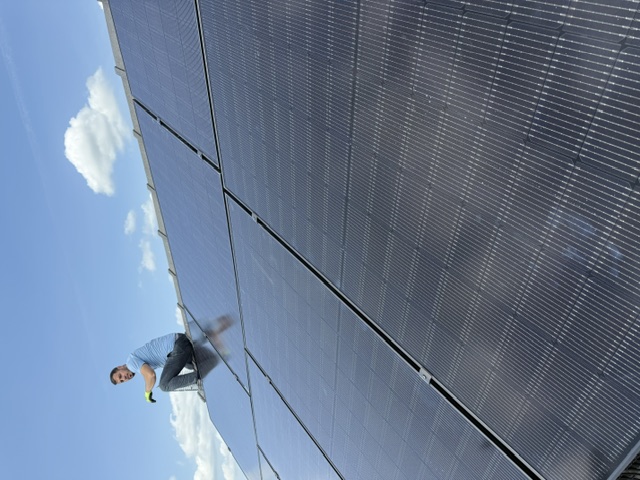
While rooftop solar is the most common installation type, it is not always the best option. Properties with north-facing roofs, heavy shading from trees or neighbouring buildings, listed building restrictions, or structurally unsuitable roofs may benefit from a ground-mounted solar array instead.
Ground-mounted systems can actually outperform rooftop installations because they can be oriented and tilted to the exact optimal angle (south-facing at 30-35 degrees in East Anglia) regardless of the roof direction. They are also easier to access for maintenance and cleaning.
When Ground-Mounted Makes Sense
Consider a ground-mounted system if:
- Your roof faces north, east, or west and cannot accommodate enough panels for a worthwhile system.
- Your property is listed and rooftop panels have been refused planning permission.
- Your roof is heavily shaded by trees, chimneys, dormers, or neighbouring buildings.
- Your roof is structurally unsuitable (e.g., old thatch, fragile tiles, asbestos cement).
- You have ample garden or land space (a 4kW system needs roughly 25-30 square metres).
- You want to install a larger system than your roof can accommodate.
Planning Permission
Unlike rooftop solar, ground-mounted systems usually require planning permission. In domestic settings, they are classified as permitted development only if they meet strict criteria: the array must not exceed 9 square metres, must not be within 5 metres of the property boundary, and must not be higher than 4 metres. Systems larger than this need a full planning application.
For agricultural land, permitted development rights are more generous. Farms can install ground-mounted solar on agricultural land under certain conditions without full planning permission, though prior notification to the local authority may be required.
Costs
Ground-mounted systems typically cost 10-20% more than equivalent rooftop installations due to the additional mounting framework, ground preparation, and cable trenching required. A 4kW ground-mounted system costs approximately £5,500-£8,500. However, the ability to achieve optimal orientation and tilt can result in 5-15% higher generation compared to a sub-optimally oriented rooftop system, partially offsetting the higher cost.
East Anglia Advantage
East Anglia is particularly well-suited to ground-mounted solar. The flat terrain means ground-level shading from hills or elevated terrain is virtually non-existent. Rural properties across Cambridgeshire, Norfolk, and Suffolk often have substantial garden or paddock space that can accommodate an array. Sandy and well-drained soils in areas like the Brecks (around Thetford and Brandon) make ground preparation straightforward.
Continue Reading
Get Expert Advice
Have questions about any of the topics covered in this article? Our team is happy to provide personalised advice for your specific property and situation.
Book a Free Survey