
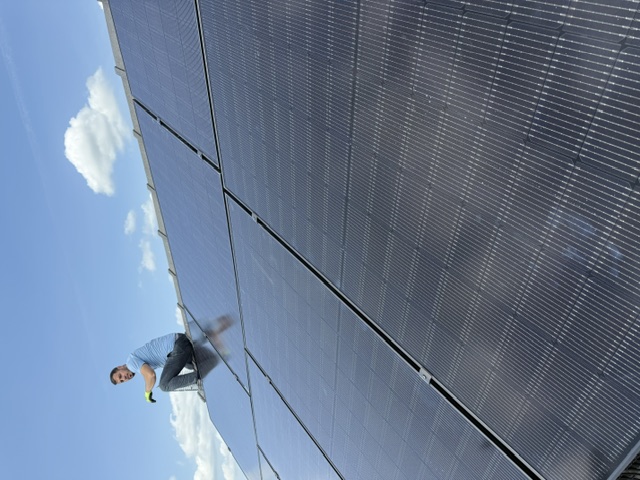
Something structural is happening in Yorkshire's electrical contracting sector. Firms that spent the last decade focused on rewires, consumer unit upgrades, and commercial fit-outs are now deriving a growing share of their revenue from solar PV, battery storage, EV charging infrastructure, and heat pump electrical work. This is not a niche pivot driven by a handful of enthusiasts — it is a wholesale repositioning of what it means to be an electrician in the region in 2026. The economics have shifted, the grant landscape has matured, and homeowners and businesses across South Yorkshire, West Yorkshire, and beyond are asking their trusted electricians to handle technologies they barely knew existed five years ago.
Premier Electrical Renewables has been at the centre of this shift, working across residential, commercial, and agricultural sites throughout Yorkshire. This piece sets out how the transition is unfolding, what the practical and regulatory demands look like from the inside, and why the firms that are investing in the technical and administrative depth to handle the full renewable stack are the ones building durable, high-margin businesses for the next decade.
The Shift from Traditional Electrical Contracting to Renewables
Traditional electrical contracting — first fix, second fix, distribution board upgrades, PAT testing, fault finding — remains necessary, but the margins are under persistent pressure. Labour costs have risen, material costs remain elevated following the post-pandemic supply chain disruptions, and competition for the same domestic and commercial work is intense. Renewable installations offer a different dynamic: the jobs are larger in scope, the average invoice value is higher, and the combination of government incentives and rising energy costs means that the pipeline is not dependent on discretionary consumer spending in the same way a kitchen rewire is.
Heat pump electrical work illustrates this clearly. A heat pump installation requires a dedicated circuit, often an upgraded consumer unit, and in many cases supply-side upgrades to accommodate the additional load. The electrical element is not a standalone contract — it sits within a broader retrofit project and demands coordination with heat pump installers, heating engineers, and sometimes DNO representatives. Firms in the South West have been navigating this landscape for longer, given the higher density of off-gas-grid rural properties. CCS Heating & Renewables in Cornwall is one example of how a regional contractor has built an integrated heat pump and electrical offering where the two disciplines reinforce each other rather than operating as separate trades. Yorkshire firms are learning similar lessons, though the housing stock and grid infrastructure present their own specific challenges.
The shift requires investment beyond tooling. Electricians moving into renewables need to understand irradiance calculations, shading analysis, battery chemistries, charger communication protocols, and — critically — the certification and grid application processes that govern grid-connected systems. Those administrative capabilities are as much a competitive differentiator as technical skill.
What MCS Add-On Requirements Mean for Electricians Going Solar
The Microgeneration Certification Scheme is the quality standard that governs solar PV installations in the UK, and it is a prerequisite for homeowners and businesses to access Smart Export Guarantee payments and to benefit from the Consumer Code protections that come with MCS-certified installations. For electricians entering the solar market, MCS is both an opportunity and a barrier.
Achieving MCS certification as an electrical contractor carrying out PV installations means demonstrating competence across system design, installation methodology, commissioning procedures, and documentation standards. The certification body will assess your quality management system, your training records, and your ability to produce accurate installation and handover documentation. This is a significant administrative investment, and it is one reason why many electricians opt initially to work as subcontractors to MCS-certified solar firms rather than pursuing direct certification — a model that works commercially but limits margin and client ownership.
The MCS add-on route, which allows a contractor already certified in one technology (say, battery storage) to add solar PV without going through the full initial certification process, has become increasingly relevant as electricians build out their renewables portfolios. The practical implication is that a firm that starts by installing EV chargers and battery storage — which do not require MCS certification — can build a renewable energy client base, develop the operational systems MCS requires, and then add PV certification as a logical next step rather than a prerequisite. This staged approach to building a renewables practice is increasingly common among Yorkshire electrical contractors in 2026.
Documentation quality is the area where MCS inspections most commonly find shortfalls. Installation reports, commissioning certificates, and handover packs need to be complete, accurate, and retained. Firms that invest in digital job management systems from the outset — rather than retrofitting paperwork processes onto an existing practice — tend to find the MCS compliance burden significantly lower.
South Yorkshire EV Charger Boom: Electrical Contractors Leading
The electric vehicle charger installation market in South Yorkshire has grown rapidly and shows no sign of plateauing. Doncaster, Sheffield, Rotherham, and Barnsley are all seeing strong demand from residential customers, businesses seeking to provide staff and visitor charging, and logistics and fleet operators building depot charging infrastructure. Electricians with the right training and OZEV installer registration are well-positioned to capture this work, and it requires less initial regulatory investment than solar PV.
OZEV registration — administered through the Office for Zero Emission Vehicles — is the gateway to installing chargers under the EV infrastructure grant scheme, which covers residential charger installations for flat and rented property residents as well as workplace and commercial site schemes. The registration process is straightforward for qualified electricians, and the technical demands of domestic EV charger installation, while not trivial, are within the competency of any competent electrical contractor who invests in the specific product training most charger manufacturers now offer.
The commercial and fleet market is where the complexity — and the opportunity — increases. Large depot charging installations, including three-phase supplies, load management systems, and smart charging communication layers, require a different level of capability than a single-phase residential charger. ElectriFusion Solutions, also Doncaster-based, has developed a strong position in the commercial EV market in South Yorkshire and offers a useful reference point for what a specialist EV charging contractor looks like at the commercial end of the market. For electricians with a commercial client base — industrial estates, logistics parks, large office campuses — the EV infrastructure requirement is one of the most predictable sources of new project work over the next five years.
The load management aspect of commercial charging deserves particular attention. Installing twenty charge points on a site with a constrained incoming supply means using dynamic load balancing systems that communicate with each charger and throttle individual units to prevent the aggregate load from exceeding the available supply. This requires electricians to be familiar with communication protocols and the configuration software for these systems — capability that goes beyond traditional electrical contracting but is learnable and increasingly expected.
G99 and DNO Applications: The Paperwork Electrical Contractors Can Navigate
One of the least glamorous but most commercially valuable capabilities a renewable electrician can develop is competence in grid connection applications. For any solar PV system above 3.68 kW, or battery storage capable of exporting to the grid, the Distribution Network Operator must be notified and, for larger systems, must approve the connection before commissioning. This process — governed by Engineering Recommendation G98 for smaller systems and G99 for larger — is often where projects stall, and it is a genuine differentiator for electrical contractors who can navigate it efficiently.
G98 applications, which cover single-phase systems up to 3.68 kW, can be submitted as a post-installation notification. G99 applications, which cover larger systems and all three-phase export-capable systems, require pre-approval and involve a formal application to the DNO, sometimes accompanied by a power flow study and a protection settings assessment. For commercial and agricultural solar installations, where system sizes regularly exceed 50 kW and can reach several hundred kilowatts, the G99 process can take weeks and will require detailed technical documentation.
Yorkshire falls within the Northern Powergrid distribution area for most of its territory, with some overlap into National Grid Electricity Distribution in parts of South Yorkshire. Each DNO has slightly different application portals, timescales, and requirements, and familiarity with the specific documentation formats each expects is a practical advantage. The electrical contractor who can submit a clean, complete G99 application first time — rather than having it returned for clarification — is the one who keeps their project programme on track and avoids frustrated customers.
Battery storage adds a further layer. Where a battery system is connected alongside solar and is capable of grid export, it will typically require its own G98 or G99 notification, and the settings on the inverter must be configured to comply with the DNO's requirements around export limiting and islanding protection. Getting these settings wrong does not just create regulatory problems — it can affect the performance and safety of the system. Electrical contractors who understand the technical basis of these requirements, rather than simply following a checklist, are the ones who can problem-solve when a commissioning test reveals an unexpected result.
National Installer Networks vs Regional Specialists
The UK solar and renewable energy installation market includes a range of business models, from large national firms with centralised sales and subcontracted installation teams, to regional specialists who handle every stage of a project with their own employees. The tension between these models is not purely commercial — it has real implications for installation quality, customer service, and long-term accountability.
National installers typically benefit from purchasing power and marketing scale. They can run national advertising campaigns, offer standardised products and pricing, and absorb the overhead of MCS compliance across a large volume of installations. Their weakness is local knowledge and accountability. When a customer in Wakefield has a problem with their system eighteen months after installation, the national firm's response chain — call centre, scheduler, subcontractor — often proves slower and less satisfying than calling a local firm where the same engineer who installed the system can come back and look at it.
Regional specialists, by contrast, carry the relationship with the customer over the long term. They know the local housing stock, the common DNO requirements in their area, the typical shading challenges on north-facing terraced properties, and the heating systems that are already installed in the homes they are working in. Lumos Energy in Wiltshire is one example of a regional specialist that has built its business around deep local knowledge and a complete in-house capability — a model that translates directly to the Yorkshire market, where property types and grid infrastructure vary significantly between urban South Yorkshire and the rural North Yorkshire Moors.
The answer for many customers is not a binary choice but an assessment of what the firm can actually deliver. A regional electrician who has invested in MCS certification, DNO application capability, and after-sales support infrastructure may offer the best of both models: local accountability with credible technical depth.
Long-Term O&M Partnerships
Operation and maintenance contracts are increasingly becoming a meaningful revenue stream for renewable electrical contractors. A solar PV system installed in 2024 has a design life of twenty-five years or more, and over that period it will require periodic inspection, inverter health checks, performance monitoring review, and occasional fault diagnosis. The installer who offers an annual maintenance contract at the point of sale is building a recurring revenue stream and maintaining a relationship that will generate referrals and future upgrade work.
For commercial clients — businesses, schools, agricultural operators with large rooftop or ground-mount systems — an O&M contract is not optional, it is a financial necessity. A poorly performing commercial system loses money every day it is not operating at full capacity. Commercial operators want a named contractor with a service level agreement, a guaranteed response time for faults, and a regular inspection schedule backed by written reports. The national network Solar Bureau connects commercial solar clients with vetted regional installers who have the capability to deliver this level of O&M service — a route to market for Yorkshire electrical contractors who want to move into the commercial sector without building a full national sales function.
On the specialist maintenance side, Manchester O&M specialists Solar Maintenance Solutions have developed a business model centred on independent solar inspection and repair work, servicing systems originally installed by a wide range of contractors. Their experience provides a useful perspective on the most common fault types — typically inverter communication failures, connector degradation, and DC isolation faults — and on what a quality maintenance visit should actually cover. For Yorkshire electrical contractors building their own O&M offering, understanding what best practice looks like from an independent specialist is useful grounding.
The commercial case for offering O&M contracts goes beyond the direct revenue. A contractor who is visiting a client's site annually has regular visibility of a customer who may be ready to add battery storage, expand their solar array, install additional EV chargers, or upgrade their consumer unit. The maintenance visit is a sales opportunity — not in a pressured way, but in the natural course of a professional relationship where the contractor is genuinely monitoring the customer's system performance and can identify genuine improvement opportunities.
Working with Premier Electrical Renewables
Premier Electrical Renewables operates across Yorkshire with a team of fully qualified electricians who have invested in the specific training, certifications, and administrative systems that renewable energy work demands. The firm handles solar PV design and installation, battery storage, EV charger installation for residential and commercial clients, heat pump electrical work, and the associated DNO application and grid connection processes.
Every installation is backed by full MCS certification where applicable, comprehensive commissioning documentation, and a post-installation support service. The firm's approach is to take complete responsibility for the electrical elements of a renewable project — from initial survey and design through to commissioning, DNO notification, and ongoing support — so that customers and main contractors have a single point of contact for everything that touches the electrical system.
For homeowners in Yorkshire considering solar, battery storage, or EV charging, Premier Electrical Renewables offers free site surveys and detailed written proposals. For commercial clients, the firm can provide feasibility studies, G99 application management, and full project delivery for installations ranging from a single workplace charger to a multi-hundred-kilowatt rooftop solar system with integrated battery storage and vehicle charging infrastructure.
As the energy transition continues to accelerate, the role of the regional electrical contractor in delivering it has never been more important. The firms that have invested in the technical depth, the certification portfolio, and the customer relationships to handle the full renewable stack are the ones that will define what electrical contracting in Yorkshire looks like for the next generation.
Continue Reading
Get Expert Advice
Have questions about any of the topics covered in this article? Our team is happy to provide personalised advice for your specific property and situation.
Book a Free Survey